Mission planning / Location and access
Turn Places Into Prompts
You do not need a spectacular destination. A short, thoughtfully checked route can offer enough texture, contrast and small discoveries for an entire afternoon's conversation.
Scout the route before writing the clues
Start with the people who will take part, not a map full of impressive pins. Ask about step-free access, resting opportunities, sensory conditions and the distance each person finds comfortable. Nobody should have to disclose a diagnosis to request a shorter route. Offer one compact base area where a team can complete every task if moving around is inconvenient.
Visit at approximately the same time of day as the proposed hunt. Check crossings, surface conditions, toilets, seating, opening hours and places to shelter. A route that looks simple on a map may contain steep paving, temporary works or an entrance that closes early. Record a permitted alternative for any location that could become unavailable.
Choose boundaries that can be explained in one sentence. “Stay inside this garden's open public paths” is clearer than a long sequence of loosely defined streets. The boundary is a limit, not a distance target. Teams should be able to finish without visiting every corner.
Route option / Public garden
Notice the living edges
- Frame the meeting of planted and built space.
- Find repetition in leaves, railings or path furniture.
- Show a sign of seasonal change without picking anything.
- Photograph a resting place while keeping it available to others.
Stay on permitted paths. Do not bait wildlife, move plants or step into flower beds. A leaf pattern seen from a bench is an equally valid answer to one discovered after a long walk.
Route option / Square or street
Read everyday design
- Show how a line leads someone through a space.
- Find a useful repair or an interesting junction of materials.
- Make a composition from repeated public-facing shapes.
- Suggest the place's activity without identifying a stranger.
Do not photograph security systems as a challenge, obstruct business entrances or use a road as a shooting position. Choose a surface detail instead if the area becomes crowded.
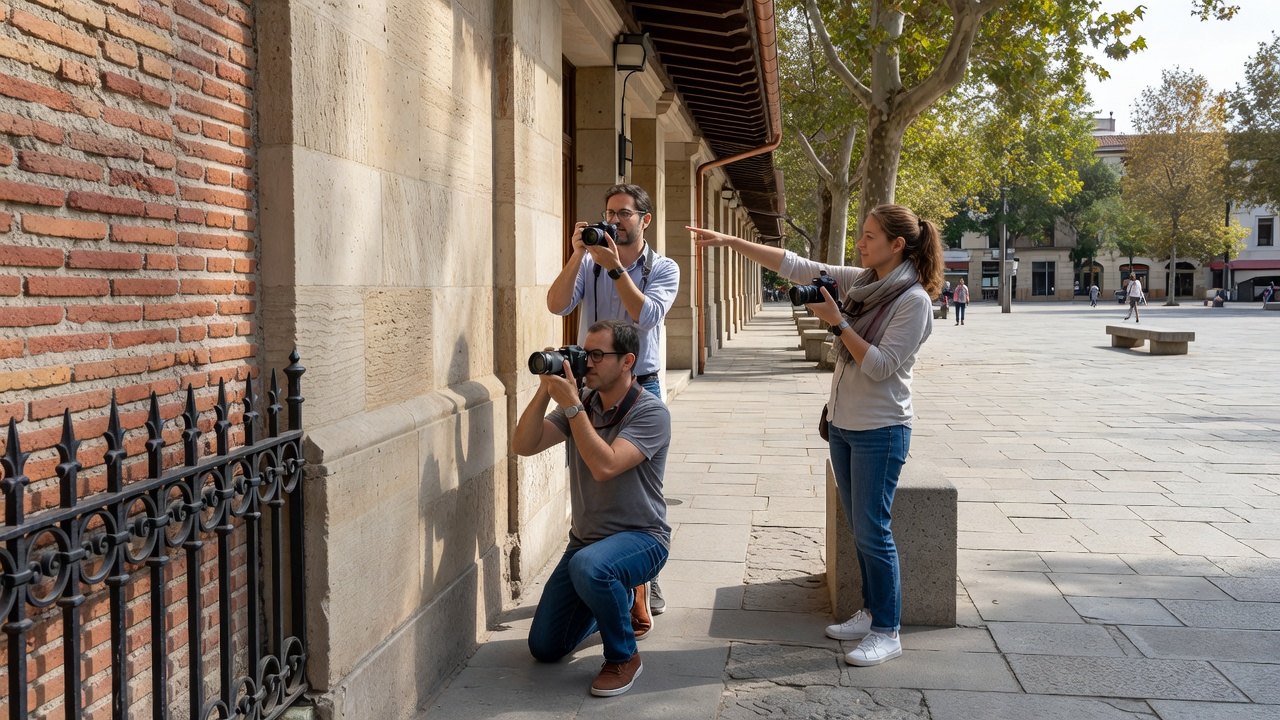
One base, many observations
Pick a comfortable, authorized viewing area and make every prompt possible there. Contrast, repetition, negative space and a visual story do not require a long route.
Let teams choose the compact or wider version without a scoring penalty. Different distances should not mean different opportunities to win.
Famous places are examples, not invitations
Central Park and Prospect Park in New York, Golden Gate Park in San Francisco, Boston Common, and Millennium Park in Chicago illustrate how paths, planting and public structures can offer different visual rhythms. In London, Hyde Park and Greenwich Park provide other examples; the High Line in New York shows how constrained routes can shape a visit. None of these names is a recommendation to assemble a group without checking the managing body's current rules.
Likewise, a place such as Borough Market, Pike Place Market or the exterior surroundings of the British Museum may be busy, managed or subject to specific photography and group policies. The Getty Center and the National Gallery have their own visitor conditions. A casual photograph, an organized competition, a tripod setup and commercial photography may be treated differently. Contact the relevant operator when your planned activity is not clearly covered.
For responsible outdoor behavior, the Leave No Trace principles offer a useful starting point: respect wildlife, leave what you find and be considerate of others. They are not a substitute for local instructions, restricted areas or the decisions of staff on the day.
Make permission part of the mission
Public access does not make every person, building interior or business available as a subject. Avoid turning workers into unpaid participants. Ask before entering a shop to make pictures, and accept a refusal without argument. If someone agrees to be photographed, explain the intended use. Permission for a private group review is not automatically permission for a public post.
Do not make an identifiable child, a person in distress or someone receiving medical assistance a challenge subject. Avoid addresses, vehicle plates and private information where practical. If a passerby becomes the main subject unexpectedly, choose another frame or remove the image from the competition when permission cannot be established.
Use a weather and access fallback
Choose a sheltered, authorized venue in advance, such as a consenting host's home or a booked community room. Rework outdoor prompts into tabletop equivalents: a path becomes a leading line, a building pattern becomes repeated objects, and a landscape becomes an arrangement with negative space. Do not assume a café or station will welcome an unannounced group activity.
Before departure, tell everyone how a route change will be communicated and where to meet if devices fail. If conditions become uncomfortable or unsafe, stop. The organizer should never need a dramatic photograph to justify ending the session. Good hosting leaves the place undisturbed and the group eager to meet again.